
This Green-Roofed Home Disappears Into the English Countryside
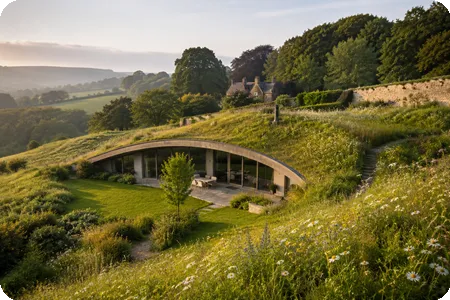
Tucked into the rolling Chilterns Hills, Ashraya is the kind of house that makes you look twice — not because it demands attention, but because it quietly dissolves into the landscape. Designed by David Kirkland of Kirkland Fraser Moor, this low-carbon Paragraph 80 home sits beneath a sweeping arched meadow roof, its form blending so naturally with the hillside that the boundary between architecture and nature nearly vanishes.
This isn’t Kirkland’s first Paragraph 80 project, but it’s among his most personal — the clients are friends and neighbors who originally wanted to renovate a developer-built house from the ’90s sitting inside a walled garden adjacent to a Grade II listed country house. Kirkland saw a better opportunity: build something truly extraordinary on the neighboring site, just outside the walled garden. What started as modest sketches grew, with the clients’ encouragement, into the bold, landscape-defining design you see today.
The road to approval wasn’t easy. Planners rejected the proposal twice before the local ward councillor brought it to committee, giving Kirkland the chance to make his case in person. The committee ultimately overrode the planning officer’s recommendation. As Kirkland explains, landscape contribution is everything in this type of project: “You must uplift the whole site and show an improvement. What you don’t want to do is take away anything of value.”
A Calligraphic Mark on the Land
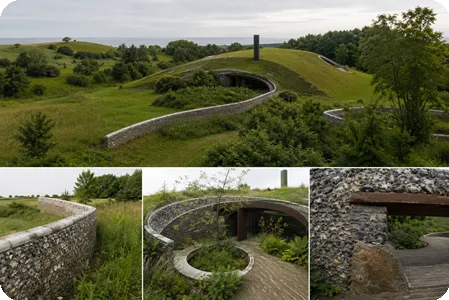
Approaching Ashraya from the road, visitors get only a teasing glimpse — an abstract composition of curves and a boldly minimal chimney, most of the structure hidden beneath its green roof. The effect calls to mind Carlo Scarpa’s Brion Cemetery, with its subtle weaving of built form and natural setting.
At the heart of the concept is a modest historic slip wall running near the site — unremarkable in appearance but significant enough that Kirkland had to carefully negotiate with the heritage officer before extending and curving it into the sweeping forms that now define the home. His intention: “to make a calligraphic mark in the landscape, like a piece of seventies land art.”
The circular courtyard at the entry reinforces this idea, with curved flint walls connecting the landscaping to the arch of the house — a subterranean slice through the earth made visible. Multiple craftsmen worked on the stone walls under tight scheduling pressure, yet their different hands are nearly impossible to detect.
Open, Glass, and Fully Connected to the Outdoors
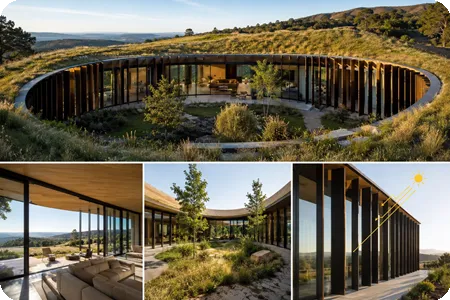
Inside, the house is a study in contrasts. The plan is essentially a rectangle sitting within a circular courtyard, with the meadow roof providing the green blanket that ties it to the hillside. Sub-spaces at the courtyard’s edges invite outdoor living, a central part of the client brief. That desire for total openness to the outside meant abundant glazing — challenging in a sustainability-focused build, but Kirkland’s team found solutions.
The glazing uses a very low G-value glass, and with the home’s east-west orientation, deep vertical fins act as solar shading — as the sun moves, deep shadows naturally reduce heat gain. The entire house is also prepped for external blinds if temperatures rise further in coming decades, making it genuinely future-proofed.
A New Approach to Low-Carbon Cooling
Sustainability isn’t a checkbox for Kirkland Fraser Moor — it’s a core design driver, and Ashraya pushed that commitment into genuinely new territory.
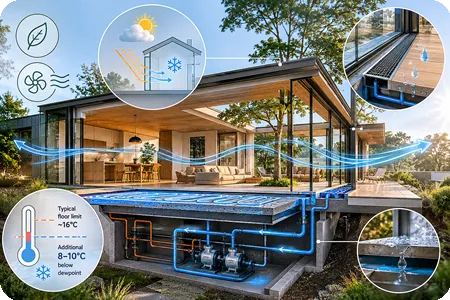
The primary challenge: how do you cool a glass-heavy home without relying on energy-intensive systems? The team knew from prior work that renewable cooling through underfloor systems was possible but limited — you can’t drop below the dewpoint without condensation forming in the screed. Typically, that floor-level limit sits around 16°C depending on humidity.
Working with Jonathan Gower of Aura, the team developed a research-grade solution: a secondary coolant system that bypasses the heat exchanger entirely, requiring no energy beyond the pumps. Connected to a series of trench radiators and designed to accept and drain any condensation, the system can cool the home an additional 8 to 10 degrees below the dewpoint. The house can essentially be chilled like a refrigerator — far beyond what’s needed today, but ready for whatever warming the future brings. Natural ventilation is also possible by opening both sides of the glazed facades.
Materials Rooted in Place
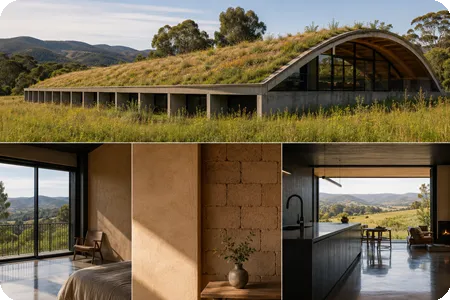
The structure moves from off-site precast concrete in the lower levels to CLT timber above — two parallel arches running roughly north-to-south support 8-meter solid CLT planks forming the curved roof. That roof carries 300mm of soil when fully planted, a substantial load when wet, yet the engineering handles it with quiet confidence. Balustrades at the base of the arch are visually absorbed into the surrounding meadow.
Inside, the material palette is intentional and locally grounded. Partition walls in the guest suites are finished with local clay plaster, hand-applied by a local artist — tactile, beautiful, and contributing to a healthy indoor environment. Unfired clay blocks from site material, made by local brickmaker H.J. Matthews, serve as partition walls and thermal mass. These blocks carry roughly a tenth of the embodied carbon of standard aerated concrete blocks.
Dark finishes — glazing frames, concrete floors, the kitchen — create a deliberate contrast with the luminous landscape views, drawing the eye outward. Reflective surfaces like the polished concrete floor amplify the effect without adding visual noise.
Architecture as Community
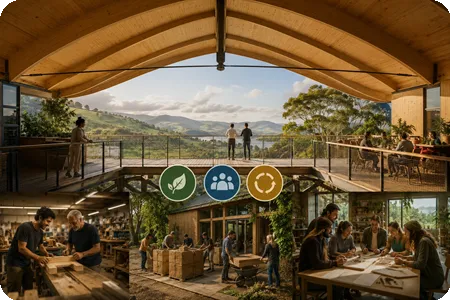
Upstairs, the first floor feels like a bridge suspended between structure and sky. Looking up at the arched CLT roof, you get the same sense of awe you might feel studying the brickwork beneath a Victorian railway bridge. From this level, you’re not merely near the landscape — you’re on it.
Kirkland Fraser Moor’s commitment extends beyond the building itself. The practice pursues what they call the “triple bottom line” — ecological, economic, and social value. Projects like Ashraya are designed to bring in local craftspeople, develop new low-carbon products, and contribute to the wider community. That philosophy also gave rise to D-Lab Studios, a community interest company that mentors the next generation of creative professionals and provides open-access maker facilities.
As Kirkland puts it: “It’s about a collegiate approach. We are trying to draw people together to do something and make something more than a sum of its parts that we can’t do by ourselves.”